
Cyborg Technology
R&D of Electric Shoulder Prostheses
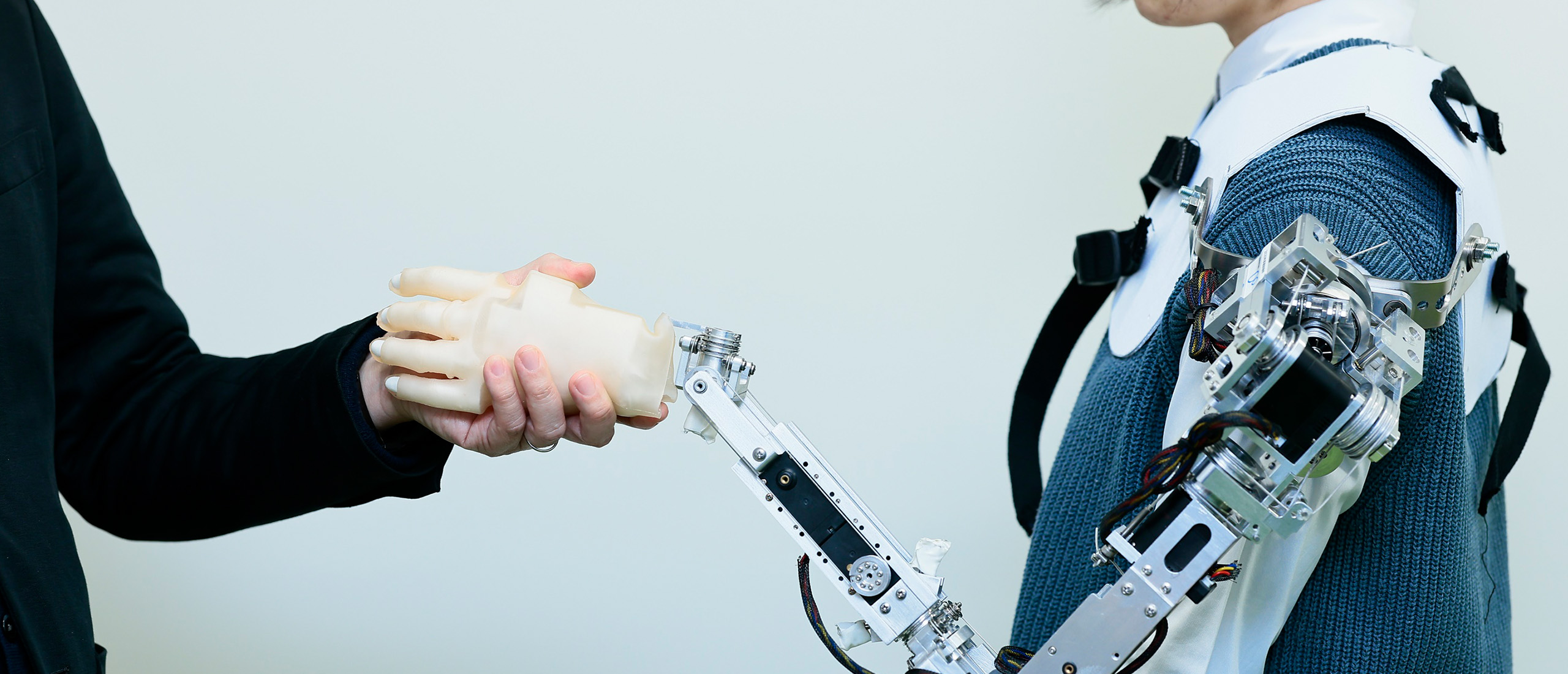
As an application of humanoid robotic arms, we develop myoelectric shoulder prostheses — electric prostheses that reconstruct arm movements for people with shoulder disarticulation, controlled by myoelectric signals. Our research covers everything from robotic arms and hands to sensor systems and control.
The prostheses developed in this project are actually evaluated by a person with bilateral shoulder disarticulation. If you are interested in using a myoelectric shoulder prosthesis, please feel free to contact us.
Current members: Shuting BAI (D) · Ryo TAKADA (M2) · Zhiguang YANG (M1)
Lightweight Multi-DoF Electric Shoulder Prosthesis
2022 – present
Overview
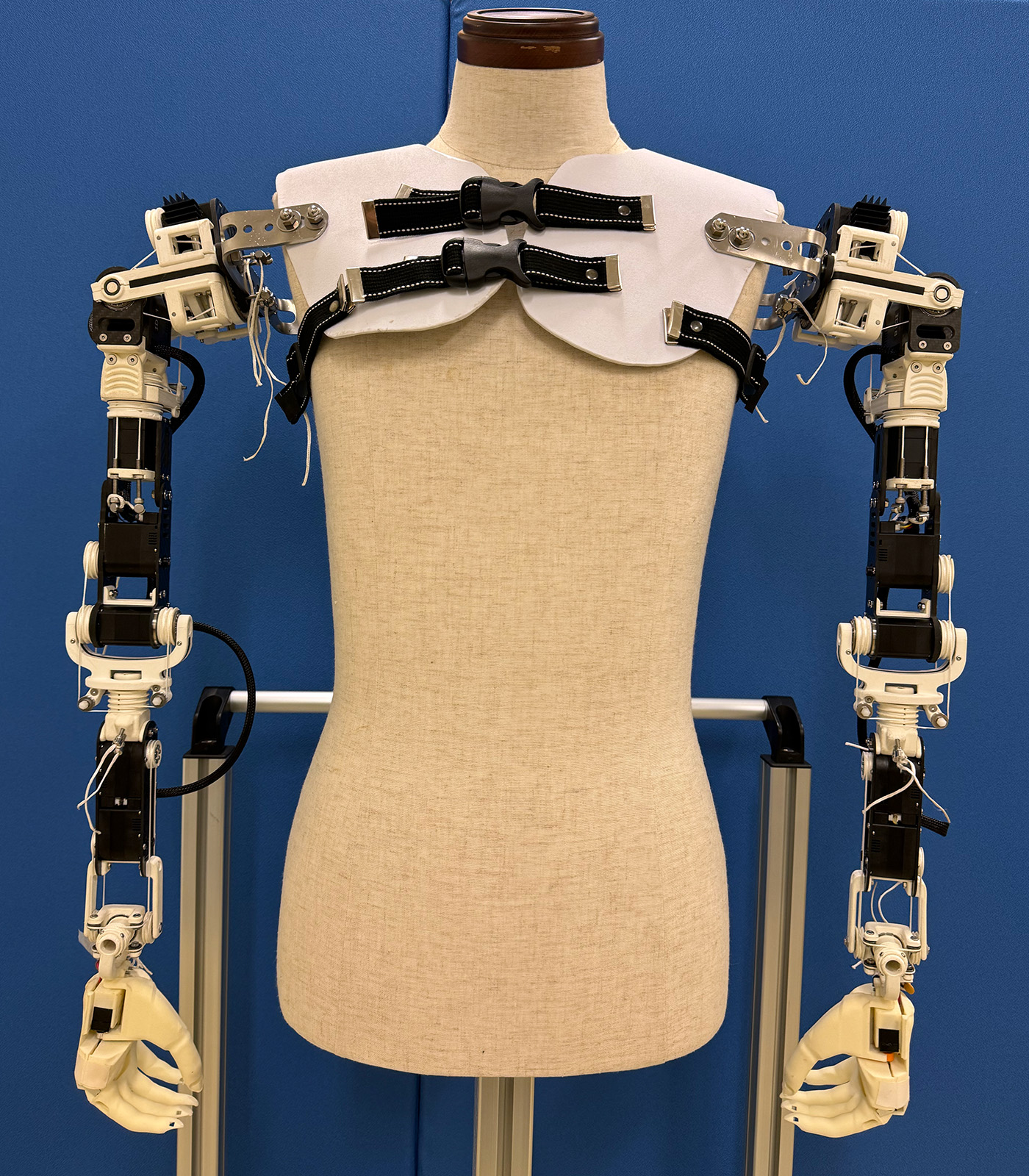
This project aims to reduce the wearing load of multi-DoF myoelectric shoulder prostheses by building a lightweight multi-material robotic arm. Since myoelectric signals are difficult to measure in people with shoulder disarticulation, motion of the remaining body parts is used as the control input to improve operability.
Technical Features
- Lightweight, high-output robotic arm using coupled tendon-driven mechanisms and a multi-material structure
- Headphone-type and sock-type devices measure shoulder and foot motion
- The prosthesis is operated by mapping remaining-body motion to hand motion
Specifications
- Weight: approx. 2.0 kg per arm
- Payload: approx. 1.5 kg
- Control: motion-mapping and semi-automatic control
Results
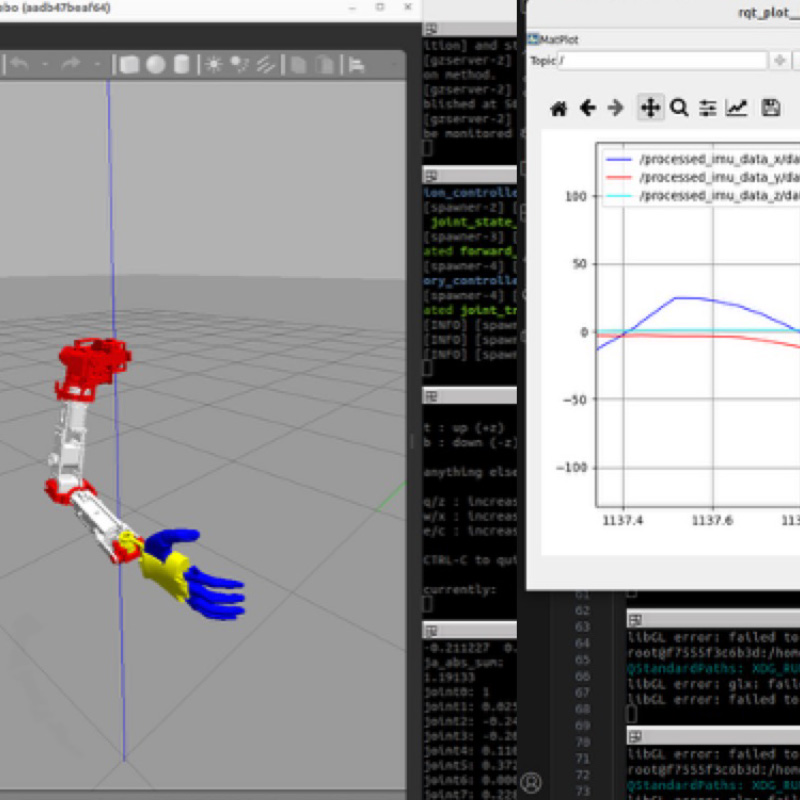
Integrated the simulation, control, and measurement systems of the prosthesis on ROS 2
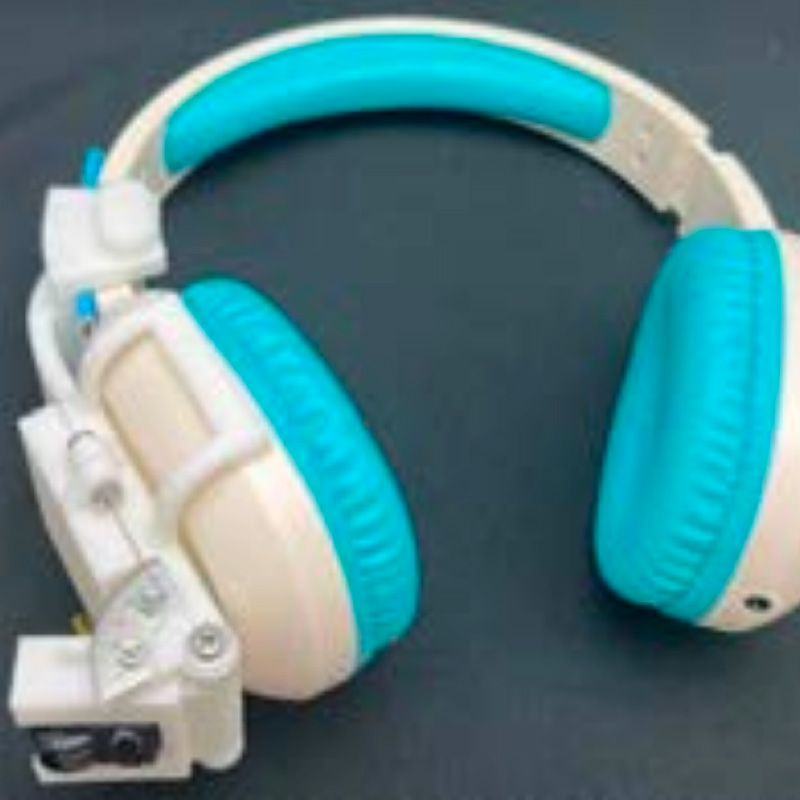
Developed a LiDAR-mounted headphone device that measures shoulder motion
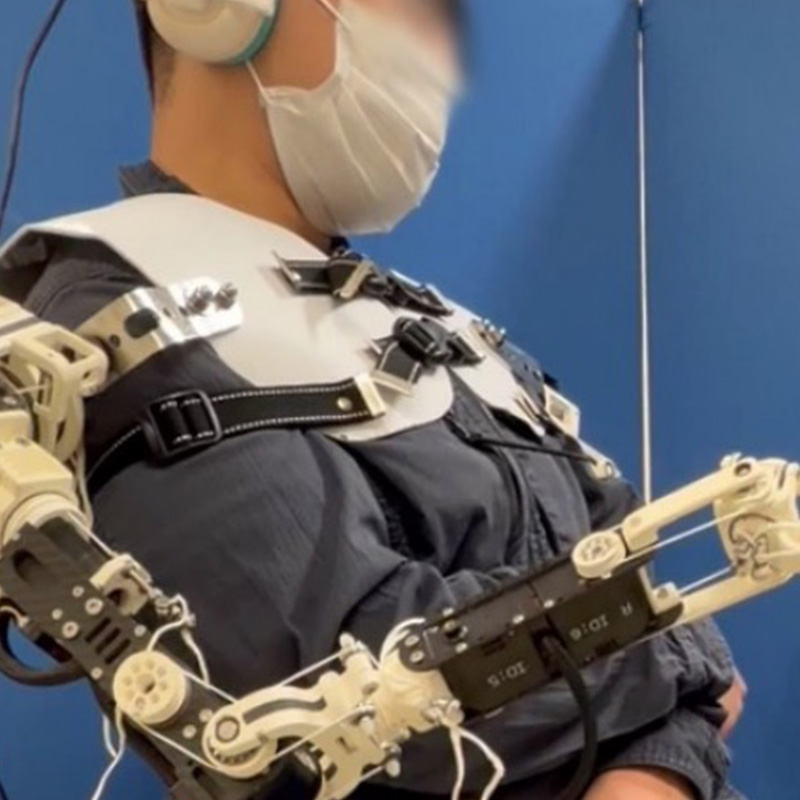
Developed a system that operates the prosthesis by combining shoulder and foot motion
Multi-DoF Myoelectric Shoulder Prosthesis
2020 – 2022
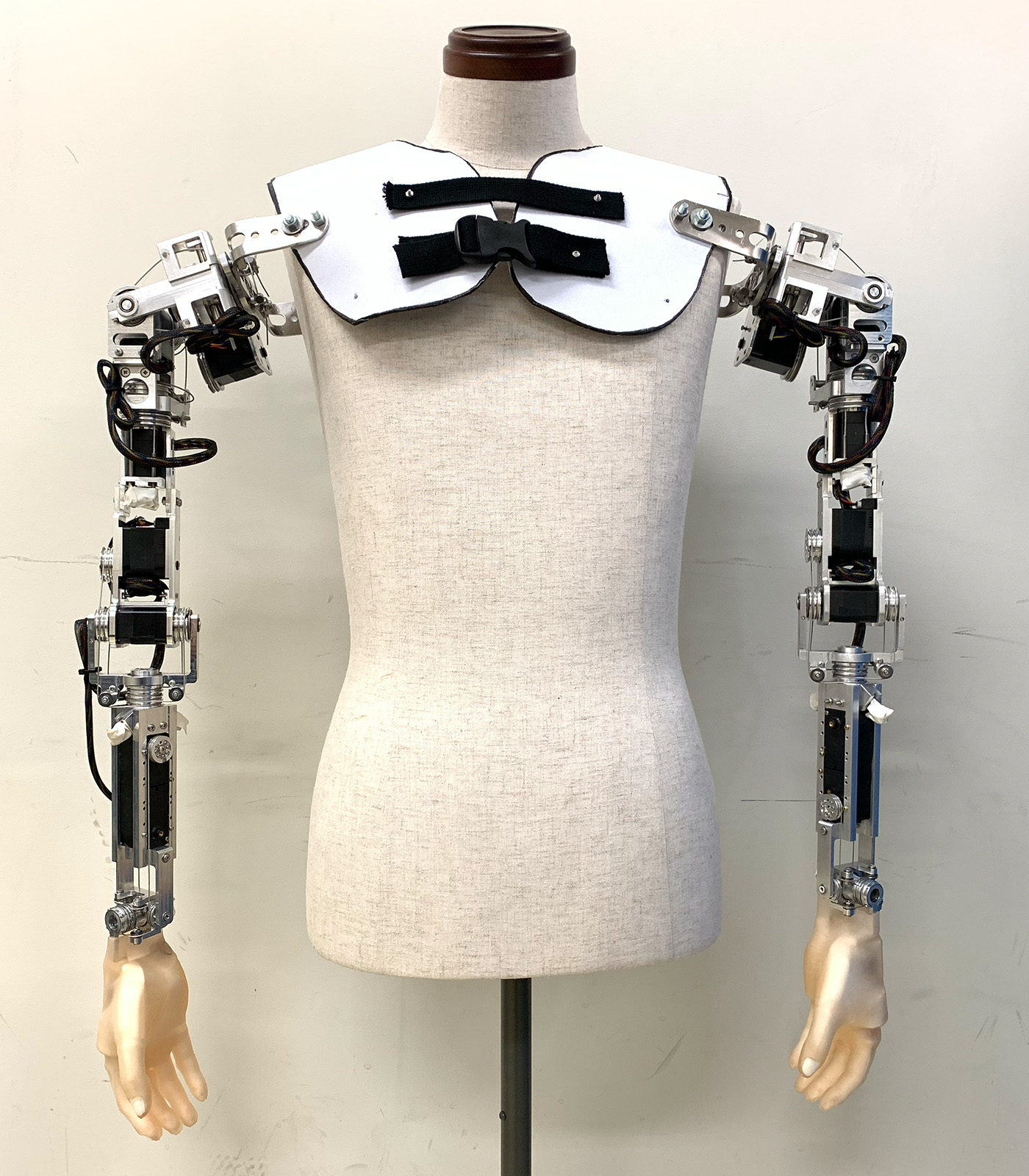
Overview
To support a wider range of activities of daily living than the simplified prosthesis, this project developed a lightweight, high-output robotic arm and intelligent control methods for a multi-DoF myoelectric shoulder prosthesis.
Technical Features
- Lightweight, high-output robotic arm using coupled tendon-driven mechanisms
- Wearable robotic arm with seven degrees of freedom, comparable to the human arm
- Vision-based reach-and-grasp motion toward target objects
Specifications
- Weight: approx. 2.6 kg per arm
- Payload: approx. 1.5 kg
- Control: learning control and semi-automatic control
Results
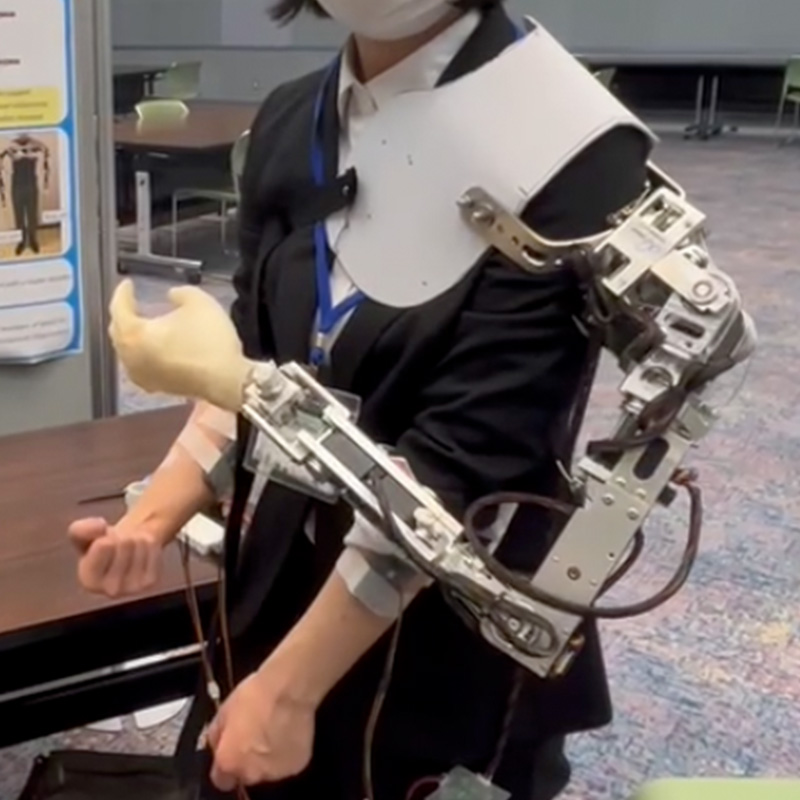
Developed a wearable, lightweight, high-output 7-DoF robotic arm
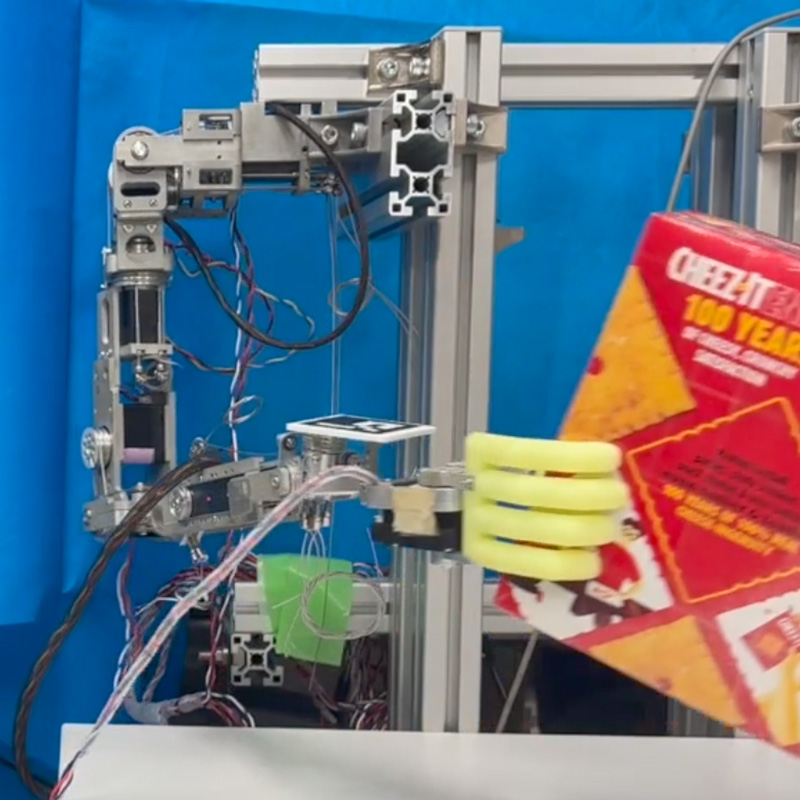
Developed a controller that detects target objects from camera images and performs automatic reach-and-grasp
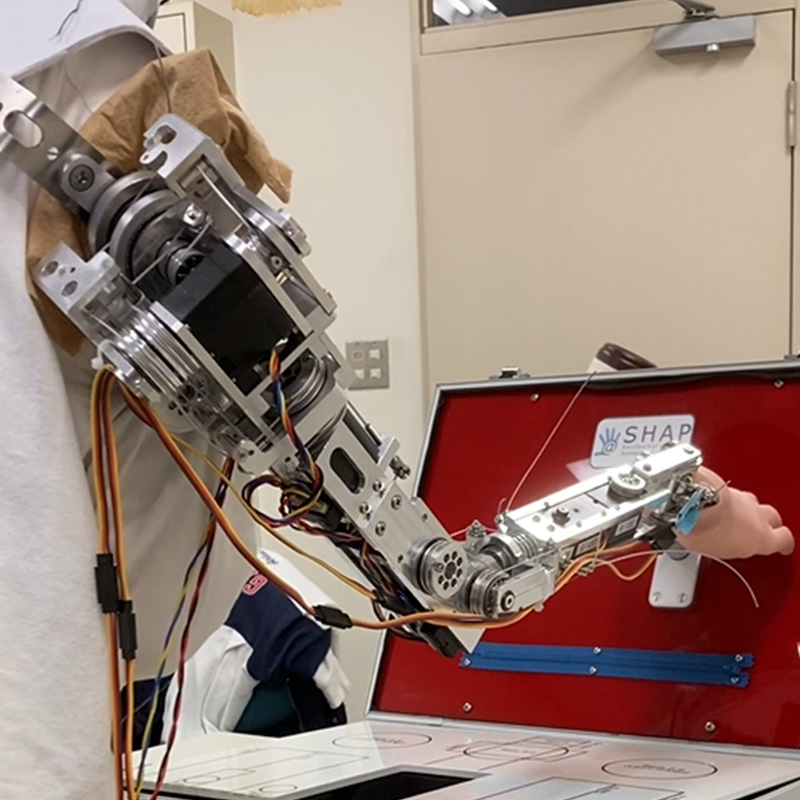
Evaluated the performance of the prosthesis using SHAP
Journal Papers
International Conference Papers
Yuko Nakamura, Yinlai Jiang, Hiroshi Yokoi and Shunta Togo, “Development of a 7 DOF electric shoulder disarticulation prosthesis using a return routing tendon driven mechanism,” 2022 IEEE 4th Global Conference on Life Science and Technologies (LifeTech2022), pp. 142–143, Osaka, Japan, 7-9 Mar. 2022. (Poster and Demo)IEEE LifeTech 2022 Excellent Paper Award for Demo Presentation
Simplified Myoelectric Shoulder Prosthesis
2016 – 2020
Overview
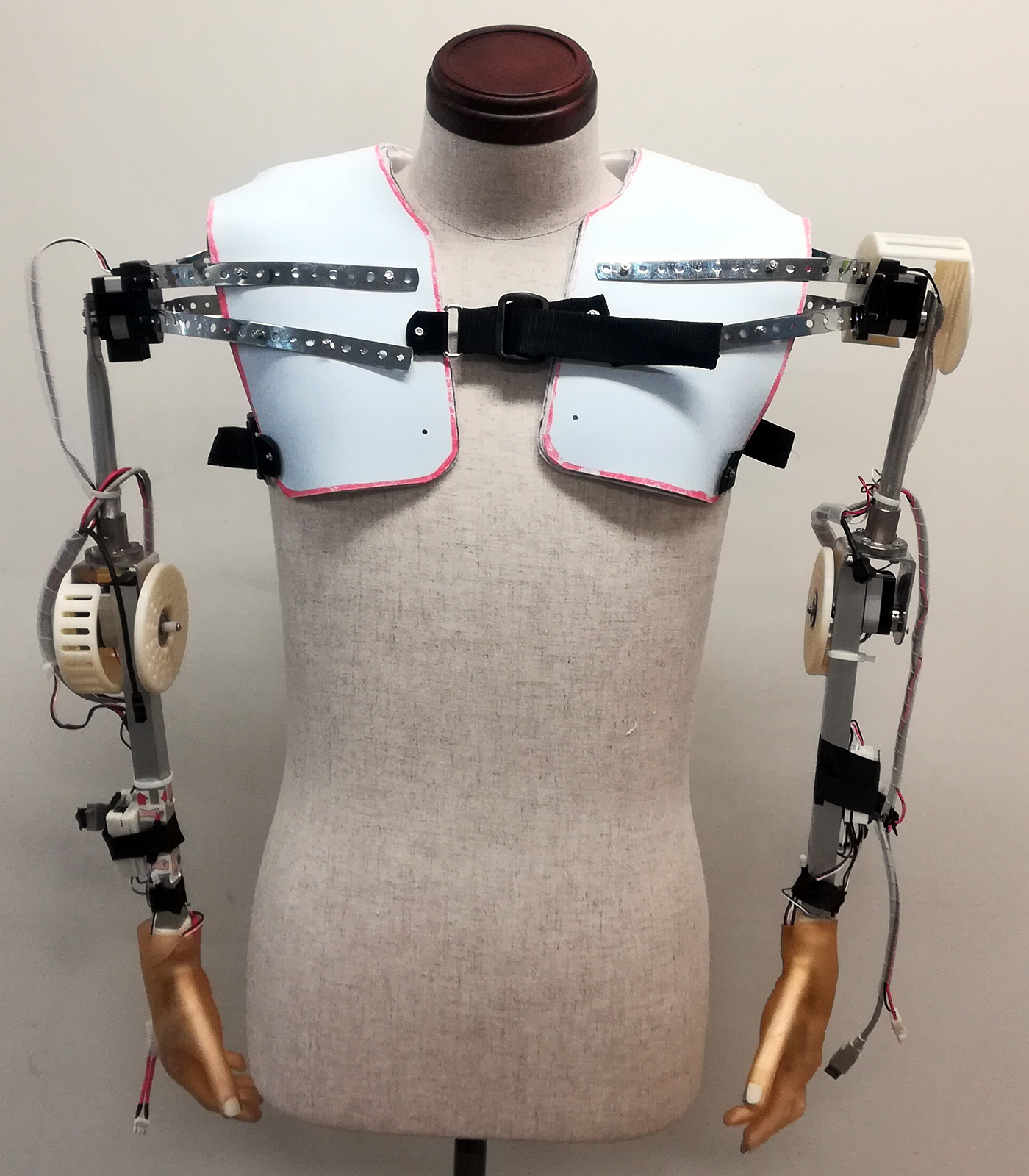
Myoelectric shoulder prostheses must control diverse arm movements with only a few control inputs. This project addressed the problem by reducing the arm to two degrees of freedom.
Technical Features
- Very lightweight thanks to the simplified mechanism
- A learning controller quickly maps myoelectric signals to prosthesis motion
- Supports hand opening/closing and raising/lowering of the arm
Specifications
- Weight: approx. 1.6 kg per arm
- Payload: approx. 500 g (short duration)
- Control: learning control and semi-automatic control
Results
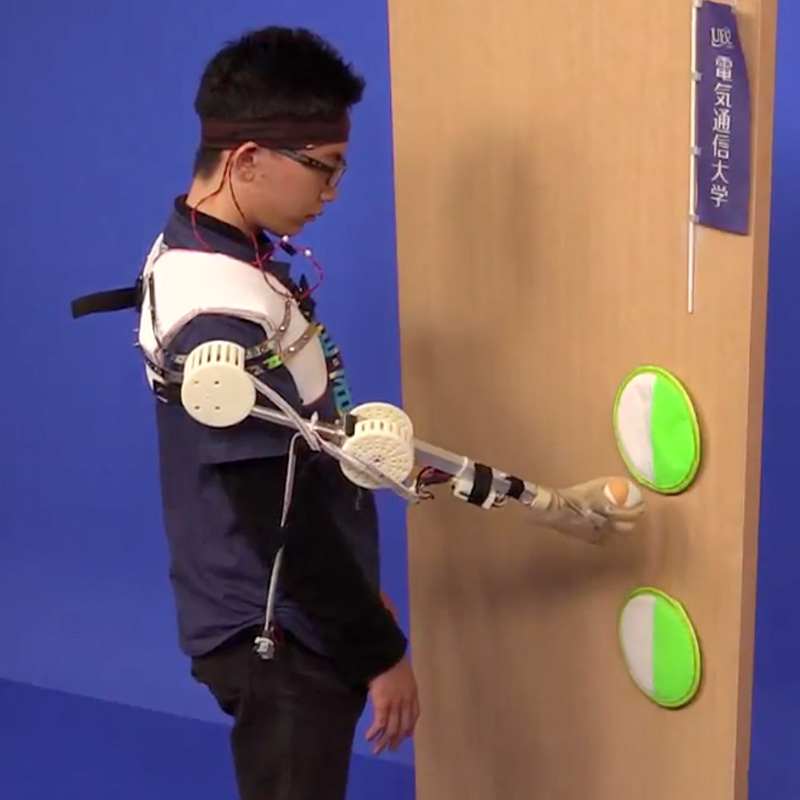
Achieved grasping and transporting a ball attached to a wall via learning control
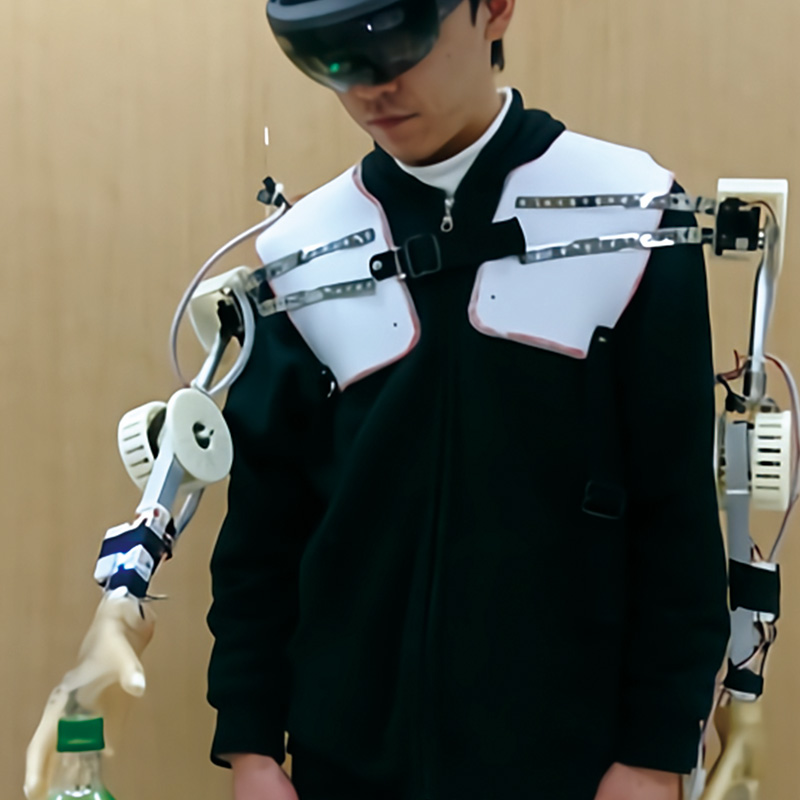
Built a semi-automatic controller that moves the hand to where the user is looking, using an MR device
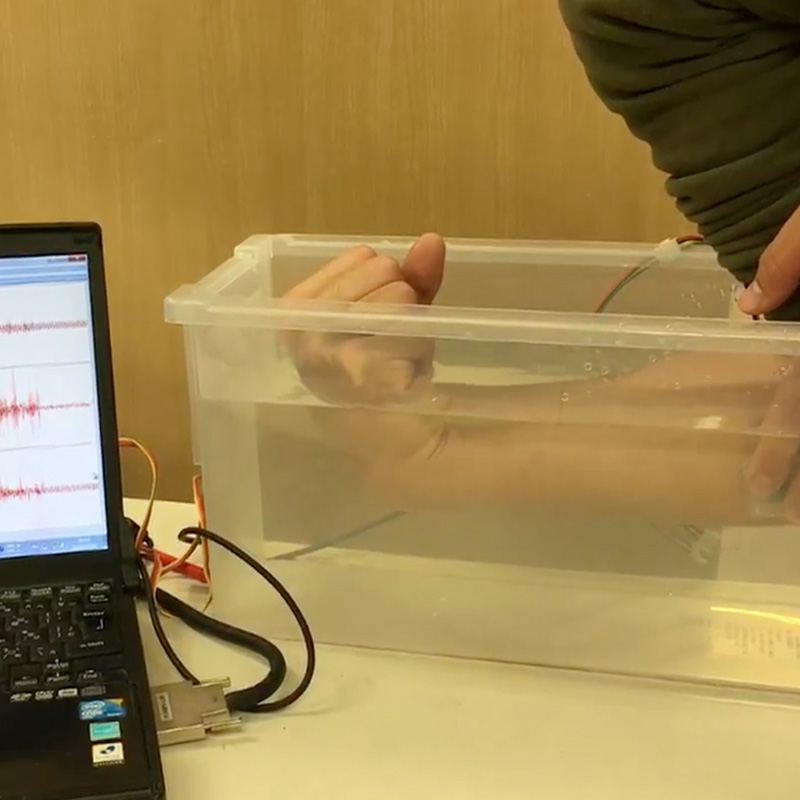
Developed waterproof myoelectric sensors by covering electrodes and boards with silicone
Journal Papers
International Conference Papers
Susumu Kimizuka, Yutaro Hiyoshi, Hesong Ye, Shunta Togo, Youhei Tanaka, Yinlai Jiang and Hiroshi Yokoi, “Development of an intuitive operation type shoulder prosthesis hand system using the surface myoelectric potential of trunk,” 2018 IEEE International Conference on Cyborg and Bionic Systems (CBS 2018), pp.597–602, Shenzhen China, 25–27 Oct. 2018.
Kazuaki Matsumoto, Susumu Kimizuka, Shunta Togo, Yinlai Jiang and Hiroshi Yokoi, “Reduction of malfunction of myoelectric shoulder prosthesis by removing ECG noise,” 2018 IEEE International Conference on Cyborg and Bionic Systems (CBS 2018), pp.489–493, Shenzhen China, 25–27 Oct. 2018.
Supported by
This R&D project is supported by the machinery industry promotion subsidy of the JKA Foundation (KEIRIN race proceeds).


Related Videos (in Japanese)
2020年度 論文 MRデバイスを用いた筋電肩義手における到達運動の半自動制御
2020年度 修論 筋電肩義手制御のための体幹表面筋電位から上肢動作を復元するシステムの開発
2021年度 修論 折り返しワイヤ干渉駆動機構を用いた多自由度電動肩義手に関する研究
2022年度 卒論 多自由度筋電肩義手の上肢機能評価に関する研究
2024年度 修論 多自由度電動肩義手制御のための肩甲骨の動作計測デバイスに関する研究
2024年度 修論 使用者の身体運動情報を用いた多自由度電動肩義手の制御に関する研究
2024年度 卒論 多⾃由度肩義⼿制御のための頭部装着型肩部運動計測デバイスの開発
2025年度 卒論 足部装着型デバイスによる多自由度電動肩義手の制御に関する研究